The endocannabinoid system

Cannabinoids are compounds that interact with the receptors found in the body’s endocannabinoid system (ECS). The ECS comprises endogenous cannabinoids (endocannabinoids) and their corresponding receptors, enzymes for synthesis and degradation, and transport proteins. The most extensively studied receptors are cannabinoid receptor 1 (CB1) and cannabinoid receptor 2 (CB2). CB1 receptors are predominantly expressed in the central nervous system (brain and spinal cord) and are activated by endocannabinoids to regulate mood, motor coordination, cognition, and pain perception. Over 144 cannabinoids have been identified in the cannabis plant, with Δ9-tetrahydrocannabinol (Δ9-THC) and cannabidiol (CBD) being the most abundant and clinically relevant. Δ9-THC acts as a partial agonist at CB1 and CB2 receptors, similar to endocannabinoids. At sufficient doses, THC can overstimulate CB1 receptors, producing the euphoria or “high” associated with recreational use. At therapeutic doses, this effect is typically mild or absent. CBD has a more complex pharmacological profile. Rather than directly activating cannabinoid receptors, CBD primarily inhibits fatty acid amide hydrolase (FAAH), the enzyme responsible for degrading the endocannabinoid anandamide. This increases endocannabinoid availability. CBD also acts as a negative allosteric modulator at CB1 receptors, altering receptor conformation to reduce THC binding affinity. Beyond the endocannabinoid system, cannabinoids interact with receptors involved in pain signalling (transient receptor potential channels, glycine receptors), mood regulation (5-hydroxytryptamine receptors), and inflammation (orphan G-protein coupled receptors, peroxisome proliferator–activated receptors).

What is the Endocannabinoid System (ECS)

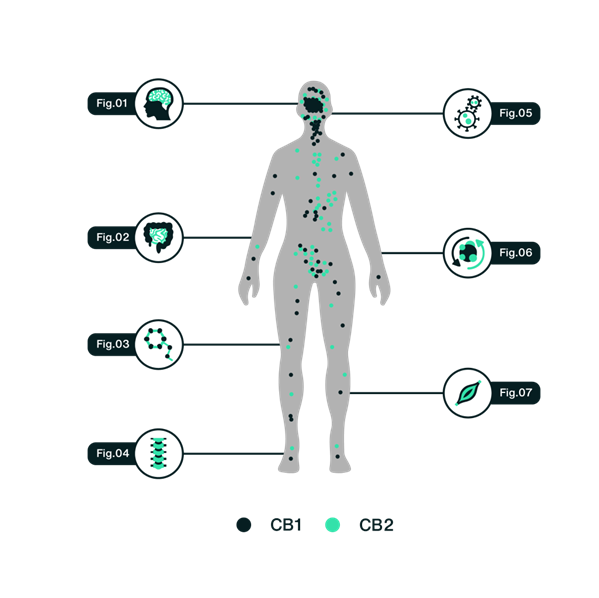
Facilitates neurogenesis, provides neuroprotection, regulates motor activity, modulates synaptic plasticity, and influences memory processing.

Regulates inflammation in the gastrointestinal tract, gastric and enteric secretions, and colonic motility.

Plays a role in hypothalamic function, regulating metabolism, reproduction and responses to stress.

Regulates bone mass, bone remodelling, and muscle function.

Modulates immune responses by regulating pro-inflammatory cytokine production.

Maintains balance by controlling food intake and metabolic functions such as energy storage, nutrient transport and modulating insulin sensitivity.

Enhances stamina by regulating blood sugar and encourages ‘runner’s high’.
Cannabinoid Receptors (CBr)
Cannabinoid receptors CBr. endocannabinoid. and enzymes form the endocannabinoid system (ECS).

The ECS is our body’s primary regulatory system and is spread out throughout the human body on nearly every organ. It helps regulate vital body functions, including:
Sleep , Memory, Mood, Appetite, Pain, Reproduction, Inflammation.

CB1 is the most abundant G-protein-coupled receptor in the central nervous system, with highest density in the brain and spinal cord. CB1 receptors are also present in peripheral organs (heart, liver, gastrointestinal tract), reproductive tissues, connective tissues, and immune cells.

CB2 receptors are predominantly expressed on immune cells (microglia, macrophages, lymphocytes) and are found in the gastrointestinal tract, tonsils, spleen, and thymus. CB2 expression increases during inflammation and tissue injury.

Many tissues express both CB1 and CB2 receptors, enabling coordinated regulation of physiological responses.

ECS

The endocannabinoid system

The endocannabinoid system is a neuromodulatory network expressed throughout the central nervous system, peripheral nervous system, and immune system. It comprises endocannabinoids, cannabinoid receptors (CB1 and CB2), and metabolic enzymes. Both endocannabinoids and plant-derived cannabinoids (phytocannabinoids) interact with these receptors to modulate physiological functions.

The ECS plays regulatory roles in:

  • Sleep: Modulates sleep-wake cycles and sleep architecture
  • Memory: Influences memory formation and retrieval
  • Mood: Regulates emotional processing and stress responses
  • Appetite: Controls food intake and energy balance
  • Pain: Modulates nociceptive signalling at peripheral, spinal, and supraspinal levels
  • Inflammation: Regulates immune responses and inflammatory processes
Conditions

Medical Cannabis May be Prescribed in a Number of Conditions

Medical cannabis may be considered for patients with diagnosed conditions where licensed therapies have failed to provide adequate benefit. Prescribing requires specialist assessment supported by multidisciplinary input. Access pathways, eligible conditions, and regulatory requirements vary between jurisdictions.

Pain conditions

  • Chronic non-cancer pain
  • Fibromyalgia
  • Neuropathic pain
  • Cancer-related pain
  • Migraine
  • Cluster headache
  • Ehlers-Danlos syndromes
  • Palliative care

Psychiatric Conditions

  • ADHD
  • Anxiety disorders
  • Autism spectrum disorder
  • Depression
  • Insomnia
  • OCD
  • PTSD
  • Tourette’s Syndrome

Neurological Conditions

  • Epilepsy
  • Multiple Sclerosis
  • Migraine
  • Parkinson’s Disease

Gastrointestinal

  • Crohn’s Disease
  • Ulcerative Colitis
  • Irritable Bowel Syndrome (IBS)

Cancer Related Conditions

  • Chemotherapy-induced nausea and vomiting
  • Cancer-associated anorexia
  • Cancer-related anxiety and depression

Contraindications

Contraindications

A thorough assessment of contraindications is a critical step in determining a patient’s suitability for treatment with medical cannabis.

Medical cannabis should only be considered if a patient has demonstrably tried and failed to achieve sufficient clinical benefit from existing licensed pharmacological treatments.

Medical cannabis products containing Δ9-THC are not recommended for patients who are or have the following absolute contraindications:

  • Cannabis-induced psychosis or other psychoses worsened by previous cannabis use
  • Unstable cardiovascular disease (e.g., arrhythmias)
  • Severe hepatic disease
  • Pregnancy, planning a pregnancy, or breastfeeding

Caution should be applied for the following relative contraindications where prescription is generally discouraged unless the potential benefits clearly outweigh the risks, as determined by a specialist.

  • Patients under the age of 25
  • Patients with a current or past cannabis use disorder
  • Patients with personal or strong family history of psychosis or bipolar disorder not caused or worsened by cannabis use
  • Hypotension
  • Risk of falls
Side Effects

Common Side Effects

Adverse effects vary depending on patient factors, cannabinoid composition, dose, and formulation. Most adverse effects are dose-dependent and resolve with dose reduction.

Very common side effects (more than one in 10 people)

  • Drowsiness or somnolence
  • Fatigue
  • Dizziness
  • Dry mouth
  • Decreased or increased appetite
  • Nausea

Common side effects (more than 1 in 100 people)

  • Cognitive impairment (attention, concentration, memory)
  • Blurred vision
  • Dysgeusia (altered taste)
  • Constipation or diarrhoea
  • Mood changes (euphoria, dysphoria, irritability)
  • Balance disturbance
  • Tachycardia

Uncommon (affecting less than 1 in 100 people)

  • Syncope
  • Blood pressure changes
  • Hallucinations (at high doses)